
Over the past few months, more of our conversations with clients have started with the same question: what do the new planning rules mean for my street?
It's a fair question. Over the past two years the Victorian Government has rezoned the areas around 60 activity centres near train and tram stations across Melbourne, and all of these plans are now in place. Closer to home, that includes North Brighton, Middle Brighton, Hampton and Sandringham in Bayside; Elsternwick, Caulfield and Bentleigh in Glen Eira; Toorak, Armadale and Malvern in Stonnington; and Hawthorn, Glenferrie and Kew Junction in Boroondara.
How it works, in plain terms
Each activity centre has a core, usually the station and shops, and a catchment around it of roughly a ten-minute walk. In the core, buildings of mostly six to 16 storeys are now allowed, with taller in some larger centres. In the inner catchment, homes of up to four storeys are allowed, or up to six on blocks over 1,000 square metres. In the outer catchment, it's up to three storeys, or four on larger blocks.
Heights step down as you move away from the station, and existing heritage overlays haven't changed.
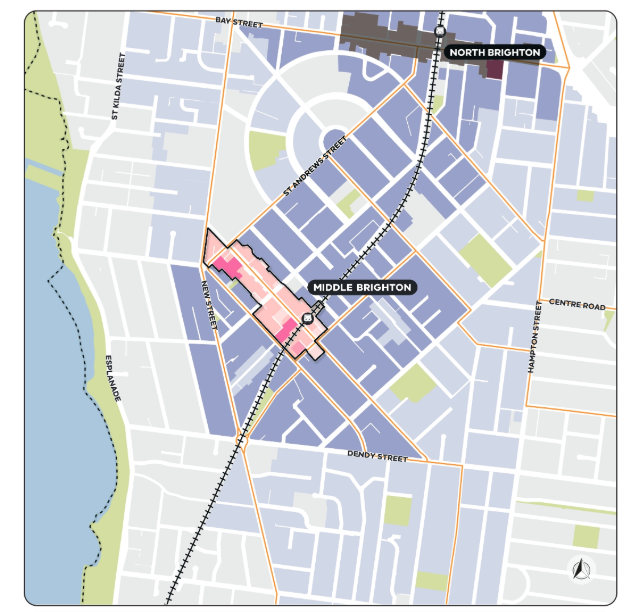
The activity centre plan for Middle Brighton and North Brighton. Check your own address on the interactive map.
Townhouses and granny flats
Two other changes are worth knowing about. Townhouses and other developments of up to three storeys still need a planning permit, but they're now assessed against a new state code. If a design meets its standards, council can't refuse it on those points and neighbours can't take it to VCAT, which makes the process simpler and more predictable. Granny flats are easier again. In most cases, a small second home on a block of 300 square metres or more no longer needs a planning permit, and since 15 October it can be up to 80 square metres, up from 60. You'll still need a building permit, and it can't be split off and sold as a separate block.
What all this could mean for you
For some owners, these planning changes open up options that didn't exist a few years ago. A block that once suited a single house might now support more than one home, or a family home with a second dwelling for parents or grown-up children.
For others, the bigger question is what might be built next door, and how that could affect light, privacy, outlook and property value. These are genuine concerns, and it's worth thinking about before you commit to a renovation, so the design protects what matters to you for the long term.
One thing to bear in mind is that while a new zone tells you what's possible in principle, your site determines what's realistic. Orientation, slope, heritage, trees and the homes around you all shape what can actually be built, and that's different on every block.
Questions I'm being asked
Is my property affected? The state government has an interactive map where you can type in your address and see whether it sits in a core or catchment.
Should I renovate, rebuild or sell? It really depends on what you want from the next ten years. If you love where you live, the new rules may let you do more with your block than you expected. If you're thinking of selling, a site's development potential can now be part of its value, and it's worth understanding that before you list.
What about the state election? Victorians vote on 28 November, and planning is one of the issues on the table. The Labor Government introduced these changes and stands by them. The Liberal-National Party Opposition has said it would scrap the activity centre zones and hand planning decisions back to local councils, and in June it tried to overturn the rules for 25 of the centres in Parliament's upper house, but the motion didn't pass.
If the rules change after the election, what happens to projects already approved? As I understand it, a planning permit that has already been granted generally stands even if the rules change later, as long as work starts within the permit's time limits. Applications still being assessed are less certain, because they're usually decided under whatever rules apply at the time. So if the new zoning is part of your thinking, the timing matters, and it's worth talking it through with us and a planning lawyer sooner rather than later.
If you'd like to know what the changes mean for your block, I'm always happy to sit down and look at it with you. Once you can see your options clearly, the next step tends to choose itself.
Book a 30-minute complimentary consultation with Jane here.
Jane Merrylees